
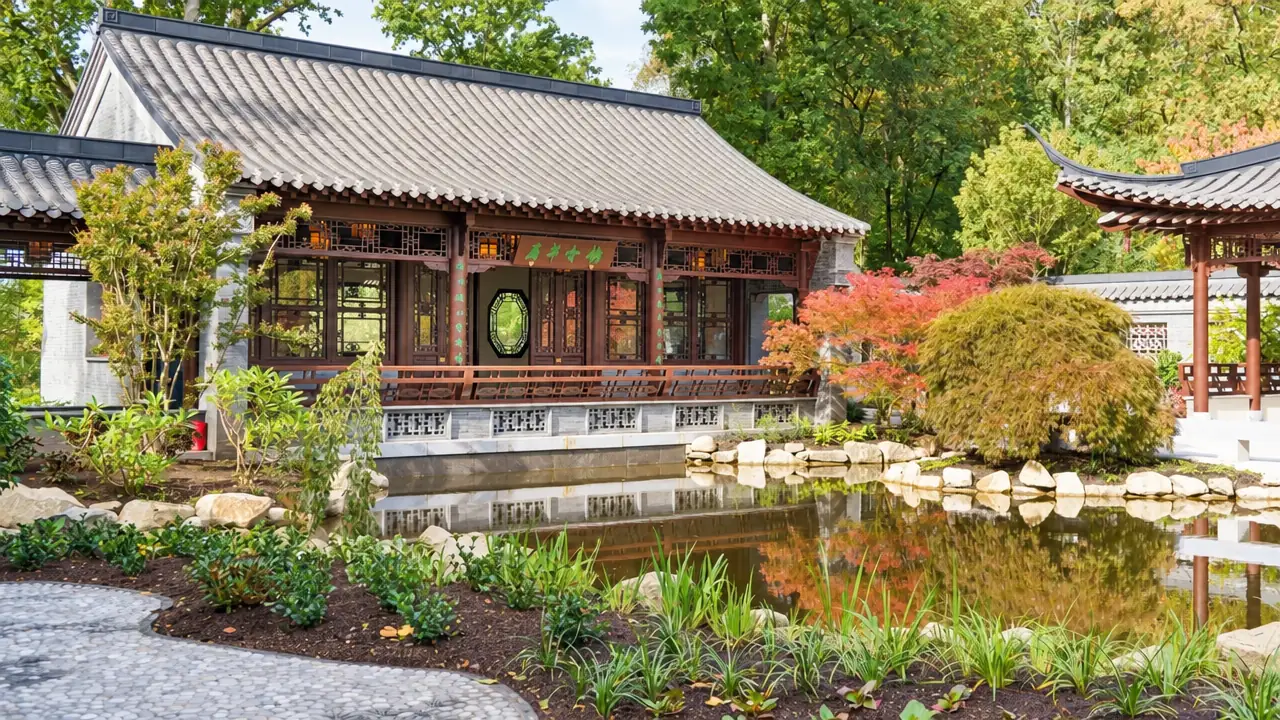
A courtyard or urban garden cannot usually accommodate the pavilions, bridges and large pool of a classical Chinese garden. It can, however, borrow an approach to placing plants and features: choose each element deliberately, then consider what it looks like from different parts of the space. A change in the position of a tree, path or gate may do more for a small garden than adding another collection of plants.
The Yangzhou Scholars Garden at RHS Garden Bridgewater, near Manchester, offers a British example to examine. Its planting, water, rocks and buildings work together rather than acting as separate attractions. The ideas below are ways to think about an existing garden or a proposed courtyard, not instructions to reproduce a traditional Chinese garden in miniature.
Start with four connected elements
Marcus Chilton-Jones, Head of RHS Garden Bridgewater, and the garden’s Curator, Tracy Snell, worked with Yangzhou City, the China Flower Association and Greater Manchester’s Chinese community on the Yangzhou Scholars Garden. They travelled to China while planning it. The courtyard garden sits within the seven-acre Chinese Streamside Garden, described in the source as the UK’s largest Chinese garden. The scale of the wider site is very different from a domestic plot, but the relationships between its features are worth considering.
Dr Peng Hongmin, Deputy Secretary General of the China Flower Association, identifies four essential elements of a classical Chinese garden. They provide a useful starting point for looking at the Bridgewater design, although a small garden need not include every element at the same scale or in the same form.
- Rocks represent mountains and the wider natural landscape.
- Water represents lakes and rivers.
- Structures shape how people enter, move through and experience the garden.
- Plants can tell stories about the garden owner’s life and character.
Rather than choosing a plant, ornament or piece of paving on its own merits alone, consider what it will sit beside, what it might reflect or frame, and where someone will see it. That way of thinking can be applied even if there is room for only a few plants and one carefully placed feature.
Choose fewer plants and give each a role
Snell says the RHS team initially noticed that the plans contained fewer plant varieties than they might have expected for a British garden of that size. In the approach used at Bridgewater, a restricted palette gives individual plants room to register. It also makes their positioning more important: another variety cannot compensate for a tree or shrub placed where its shape is hard to appreciate.
A small island bed illustrates the idea. An acer could be its central tree, with a low, mounded rhododendron or azalea beneath it and liriope forming a simple ground-cover layer. The arrangement supplies a tree, a shrub and lower planting without asking many varieties to compete for attention. Its appeal comes from differences in height, outline and foliage as well as from any flowers.
This does not mean that every bed must contain those particular plants. The transferable point is to decide what each layer contributes before adding another. In a paved courtyard, for example, one tree with restrained planting around it may be easier to read as a feature than several unrelated specimens spread across the available space. In a larger garden, the same approach could distinguish one garden room from its surroundings.
Plan for interest beyond the flowering season
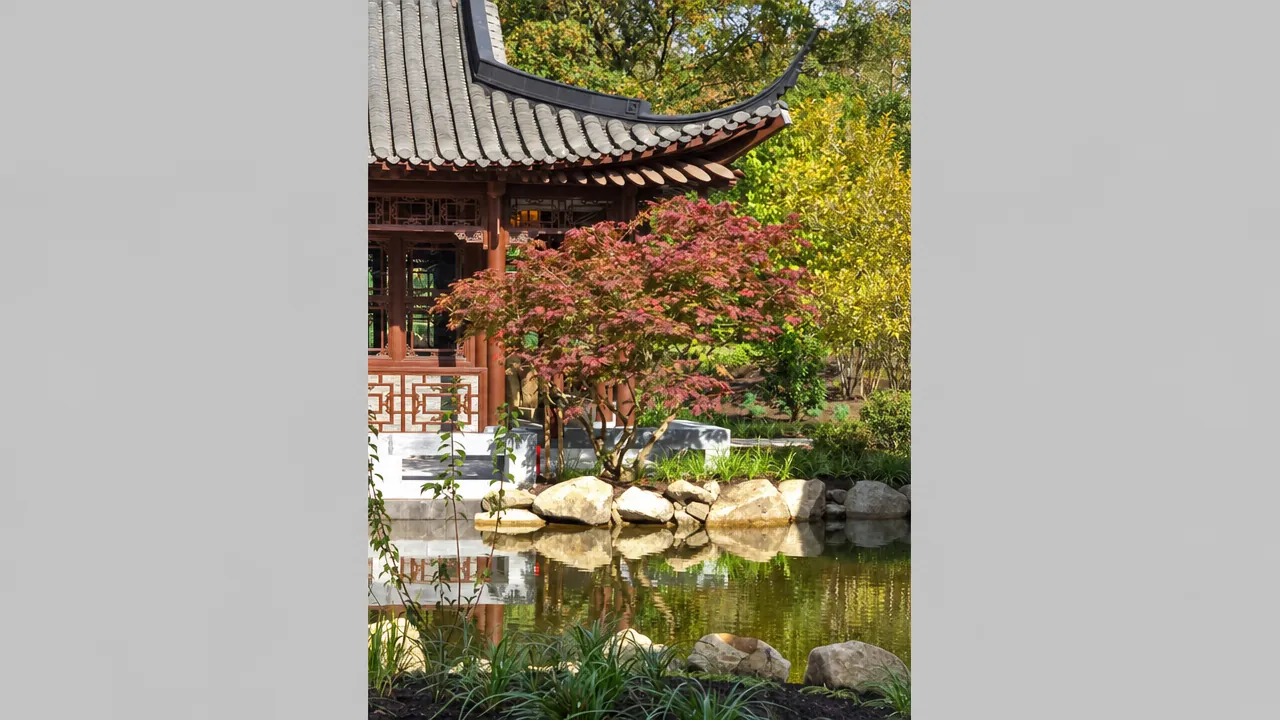
At the Yangzhou Scholars Garden, foliage plays a larger part across the year than it would in a colourful summer herbaceous border. Spring-flowering trees and shrubs can give way to green foliage in summer and stronger leaf colour in autumn. In winter, bare branches, rocks and evergreens, including cloud-pruned conifers, still provide outlines and focal points. The emphasis is not on a constant floral display.
When considering a plant, look past the short period when it flowers. Ask what its leaves, shape and branching will contribute for the rest of the year, and what will be visible behind or beneath it. A tree that is striking in autumn may also have a useful winter silhouette. Conversely, a plant selected only for its flowers may have a less convincing role once they have gone.
The other elements matter in this calculation too. A rock or a framed opening retains its position when planting changes with the seasons. Thinking about them alongside foliage helps a small garden keep a legible structure without relying on a succession of new additions.
Give a tree space to be seen
Chilton-Jones contrasts the treatment of trees at Bridgewater with a familiar arrangement in UK gardens: trees may serve as focal points, but they are also often absorbed into mixed planting around the boundary. He describes trees in Chinese garden design as individual features, sometimes positioned asymmetrically to echo a natural-looking composition. This is an invitation to reconsider the automatic choice of putting every tree along a fence.
A tree could instead stand in a small bed of its own, occupy a carefully chosen position within a paved area, or sit where it is visible from a frequently used window. Simple underplanting might consist of a mid-height shrub and ground cover. If there is a pond, the tree’s reflection could become part of the view. Each possibility gives the tree a particular relationship with its surroundings rather than treating it as background planting.
Where space is tight, consider the eventual size of the tree as well as its immediate effect. Chilton-Jones suggests that a tree chosen to suit its space, with modest planting beneath it, can bring interest to a hard surface without requiring elaborate planting. Some compact, sculptural maples at RHS Garden Bridgewater demonstrate the effect he has in mind.
Let a path reveal the garden gradually
A path need not provide only the shortest line between two points. Chilton-Jones’s natural-looking approach extends to routes that move around a tree, rock or other feature. Even a modest change of direction can interrupt a full view of the garden and make the next part visible a little later. The aim is not to add turns for their own sake, but to consider what someone sees while walking.
- Allow a feature to draw the route around it rather than forcing the feature beside a straight path.
- Consider whether a bend could conceal one part of the garden before revealing it.
- Look at the sequence of views from the start of the path to its destination.
- Use a change of direction to encourage exploration and make the journey feel longer.
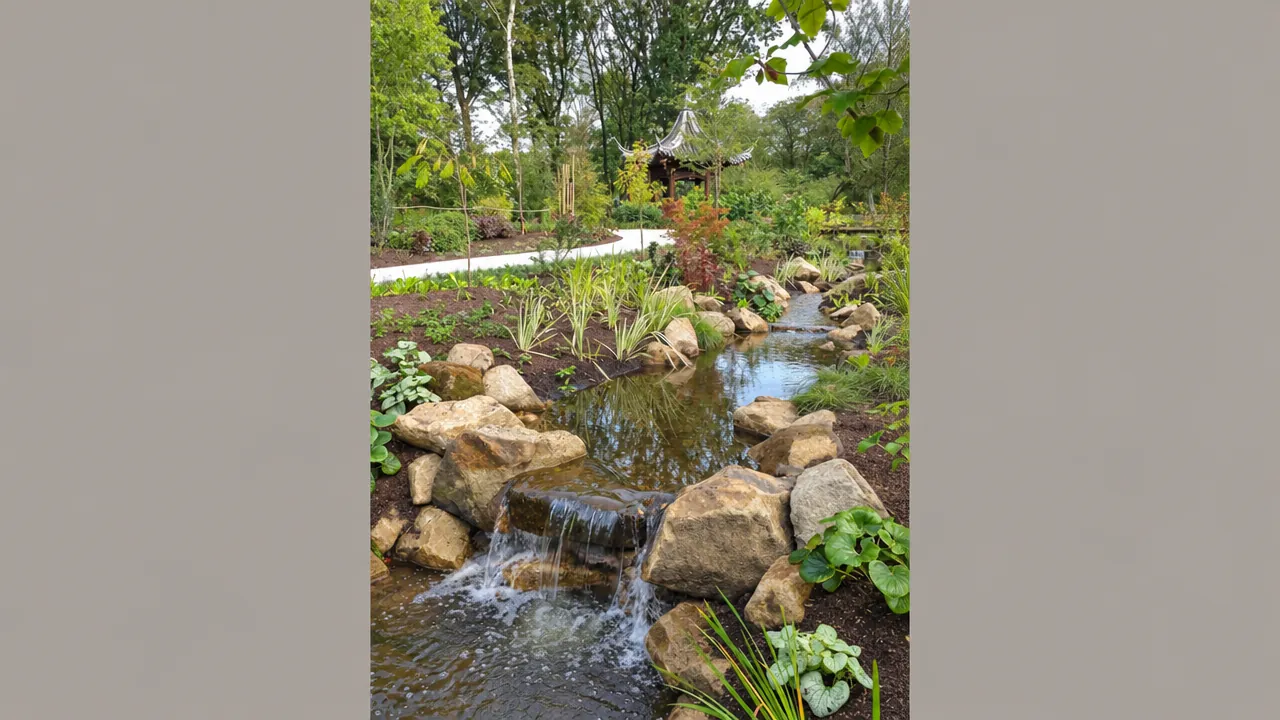
At RHS Garden Bridgewater, a central meandering path follows the stream and crosses bridges in the Chinese Streamside Garden. Walkers catch glimpses of the Yangzhou Scholars Garden along the way. A domestic plot will offer a shorter journey, yet the same question remains useful: does the route show everything at once, or can it lead the eye through the space in stages?
Frame views with openings you already have
The moongate at the Yangzhou Scholars Garden is both an entrance and a frame, with a view from either side. If planning such an opening, Chilton-Jones advises thinking about its orientation, including whether morning or evening sunlight might shine through it. What appears within the opening matters just as much. A focal point may be visible on one side or both, while relatively simple planting around the gate keeps the view clear.
Building a moongate is not necessary to use that principle. Chilton-Jones points to ordinary openings that can do similar visual work: a house or shed window, a doorway, a garden gate or a gap in a hedge. Look through each one from the position where you normally encounter it. The view from a kitchen window may matter more in daily life than a view designed only for someone standing in the middle of the lawn.
Check what is directly ahead when the back door opens and what comes into sight through the garden gate. Then look beyond your boundary. A tree, church tower or other attractive feature outside the garden might be something to frame rather than screen out. The useful decision is not simply where to put an opening, but what the opening asks someone to notice.
Treat water as part of the composition
Water is central to the Yangzhou Scholars Garden and is one of the four elements described by Dr Peng. Its pool is roughly swimming-pool sized, according to Chilton-Jones, so its dimensions offer little direct guidance for most home gardens. The more adaptable idea is its position as a focal point. Water need not automatically be assigned to an unobtrusive corner if there is a place where it could help organise the whole view.
Before deciding where water might go, consider where it would be seen from and what it would reflect. A tree, urn or statue could become part of its surface as well as part of the surrounding garden. Consider how nearby plants meet the water, and whether rocks or other features would strengthen the relationship. The water’s role depends on these connections, not simply on whether a pond is present.
Chilton-Jones describes ornamental, calming water as a particularly useful idea to take from Chinese garden design. In a smaller space, the point is to scale down the feature while still giving thought to its setting. A modest area of water placed where it can be seen and where its reflections have been considered may express the principle more clearly than a larger pond hidden from the main viewpoints.
Place rocks in relation to other features
In Dr Peng’s account, rocks represent mountains; alongside water, they can also represent yin and yang. Chilton-Jones considers rock placement one of the more readily adaptable ideas for a home garden. Rather than selecting a rock and then finding an empty spot for it, think about the job it could do in the wider composition. Its meaning and visual effect depend partly on what is close to it.
A rock might mark a turn in a path, guide someone towards a view or sit beside water. It could be paired with a striking small tree and otherwise simple planting. Several rocks could form a natural-looking, asymmetrical group rather than an even row. Check the arrangement from different points in the garden: a grouping that makes sense from one direction may be less clear from another.
These are alternatives rather than a list of features to fit into every plot. A single well-positioned rock can have a clearer purpose than several placed without regard to paths, planting or viewpoints.
Use bamboo and pruning to shape light and outline
The bamboo near Bridgewater’s moongate illustrates how planting can work with a structure. Chilton-Jones notes that bamboo can become a thicket; removing some lower foliage may reveal attractive yellow or black stems. At the moongate, the intention is closer to arranging individual stems, leaving enough space to notice their shapes and the shadows their foliage casts against the wall.
The planting there was still developing in the source account, and this more sculptural treatment requires careful management. RHS Garden Bridgewater uses underground bamboo barriers to address spreading. The relevant lesson for another garden is not that bamboo belongs beside every gate, but that the space between stems, and the light passing through them, can be considered as part of the planting design.
Trimmed and topiarised trees and shrubs are another element discussed in the source. Chilton-Jones describes Chinese tree pruning as a considered way of producing sculptural shapes. He says it has influenced members of the Bridgewater team, who have begun applying a bonsai approach to a self-seeded oak sapling. Such work is distinct from simply adding more plants: it changes the outline of a plant already in the garden.
Make existing structures work harder
Structures are the fourth element in Dr Peng’s account. The Yangzhou Scholars Garden is a courtyard with four traditional pavilions representing writing, painting, chess and music. They were built to Chinese designs using traditional craft techniques. Chilton-Jones acknowledges that reproducing its corridors and pavilions would be beyond what most domestic gardens can accommodate.
An existing gate, paved area or path can still take on more than one role. A gate can frame a carefully chosen view as well as admit visitors. Paving can provide a setting for a tree instead of remaining an uninterrupted expanse. A path can control the order in which features become visible, not merely connect the house to the far end of the garden.
Look at each structure alongside the planting rather than treating built and living elements as separate plans. This is especially relevant in a courtyard, where walls and openings are already prominent and there may be little room for additions. What matters is how the available structures direct attention through the space.
Apply the ideas to a paved or compact space
Chilton-Jones gives a practical British example: front gardens that have been paved for parking. In his view, parking and planting need not always be an either-or choice. Removing a small area of paving for a suitably sized tree and simple underplanting could soften the space and create a focal point. He qualifies the low-maintenance potential of this approach: the tree must ultimately be the right size for its position.
A small courtyard presents a related challenge. Before adding anything, identify the views that matter most: perhaps from a door, a window and the point where someone enters. Then consider whether one tree, a restrained planting combination or a feature placed beside a path could serve more than one of those views. The answer may be to reposition the emphasis, not to fill every available gap.
It helps to review the garden as a set of relationships. Is a tree able to stand out, or lost among other plants? Does a path make the space feel like a journey? Could a rock have a clearer connection to water or planting? Are light and shadow part of the view from a doorway? These questions keep attention on the design decisions illustrated at Bridgewater without requiring its scale or traditional buildings.
Snell’s observation about the restrained plant palette captures the broader approach: fewer varieties can make individual choices count for more. At RHS Garden Bridgewater, that restraint does not mean less planning. The position, shape and relationship of each plant, rock, route and structure become more noticeable when there are fewer competing elements.